The following article was featured on Photographylife.com. As it has now been archived, and I feel it still does a decent showing of communicating the vibe and atmosphere of this truly unique and mesmerising place, I have decided to share it here.
Entering Etosha National Park
As the wheels of the Land Rover cracked across the dry crust of the Namibian soil I gazed across the plains ahead. It was July and the dry season was in full swing. Arriving from the lush Zambezi, my thoughts were still filled with the smell of damp bush and water reeds. Etosha, I was to discover, is an altogether different place.
Approaching the centre of the park one sees a vast salt pan surrounded by grasslands covered in bone-white sand. The closer you come to the centre, the farther you can see on all sides, beyond the pale shrubbery into the smoky veil of the veld. Etosha does not rise before you. It expands.
Dust rises in the vaporous thermals of the sand flats at the slightest whisper of wind, casting soft shadows across the landscape. The heat is astounding, creating a haze so dense it comes almost alive as it dances across the horizon.
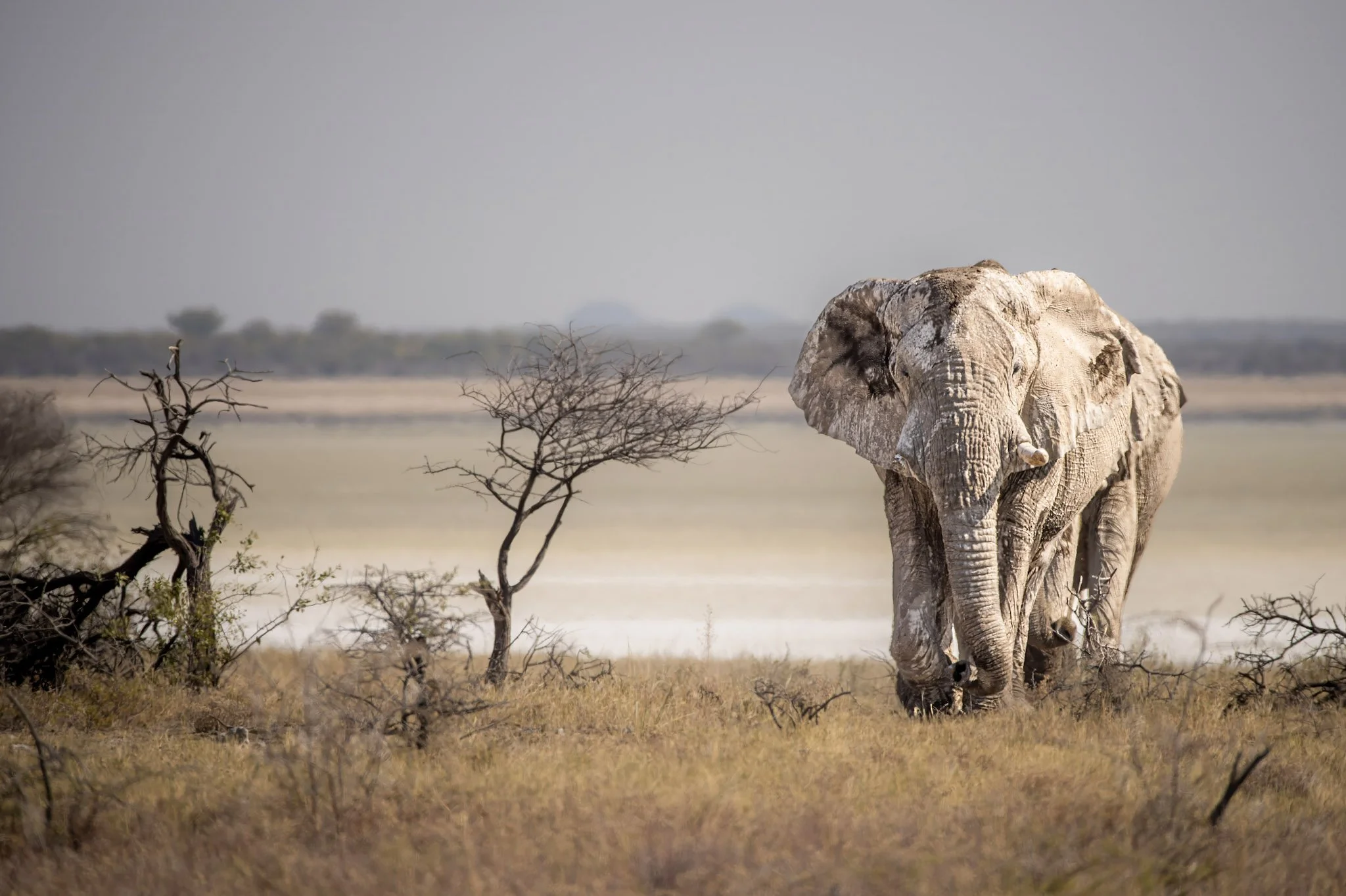
Three large bull elephants emerging from the haze of the Etosha salt pan.
The Salt Pan Elephants
Nowhere is this more potent than at Etosha’s center. At midday the entire salt pan seems a giant unlit gas burner, releasing columns of clear shifting air into the atmosphere. Through this thick air emerge what for me became one of the most impressive spectacles of Etosha: its elephants.
Etosha has many elephants, and being used to those of the denser bushland of Tanzania, the Namibian animals seemed - and as I would later come to find out, are - larger. Equally striking is the way the environment of the salt flats affects their appearance. Elephants habitually toss sand and dust over themselves. In Etosha this activity paints them white, sometimes so thoroughly that their hide approaches the colour of their tusks. It can be an unearthly experience to see these pale shapes shifting through the faraway bush, wrapped in the shimmer of heated earth. Up close they lose their spectral quality but remain remarkable, like massive moving statues, the crunch of their feet scattering sound in the quiet.

A solitary Black Rhino gazing across one of the many watering holes at Etosha National Park.
On my second day in the park I spotted a black rhino, a real treat, even more so for someone more accustomed to East African reserves. He ambled alongside the vehicle for at least a kilometre, paying little attention to his observers. After allowing enough time for photographs he vanished back into the bush, surprisingly quiet for such a large animal. I was to discover that rhinos in Etosha were not a once-in-a-lifetime sighting. By the end of my stay I had seen more than exist in the entire Serengeti. Although poaching pressure has increased in recent years, it was still encouraging to encounter such a thriving population of this ancient animal.
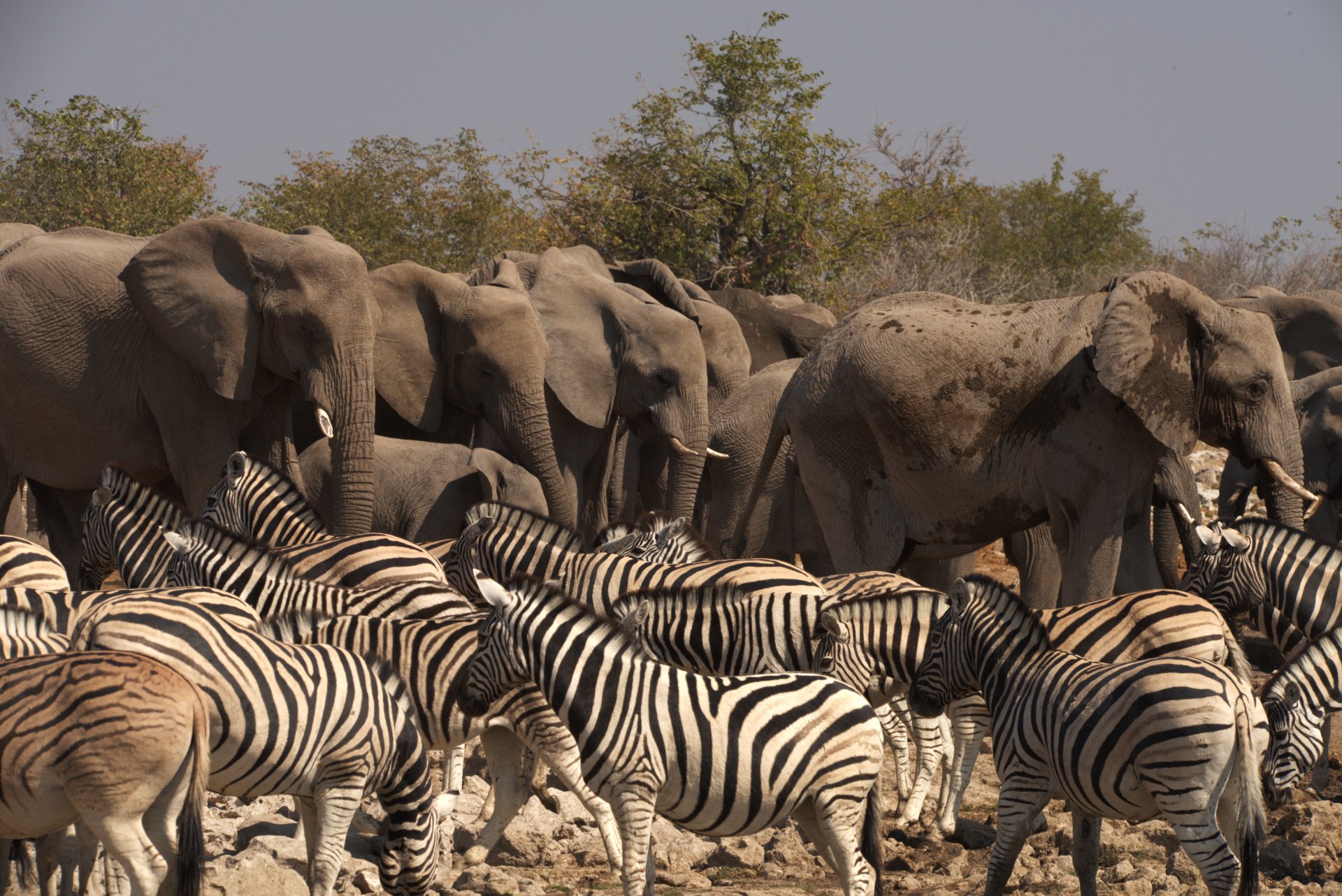
A cacophony of noise at the watering holes of Etosha as herds of elephant, kudu, impala, zebra and more congregate for an afternoon drink.
The dry, open plain of Etosha provides excellent viewing. Water-seeking animals congregate at the scattered waterholes, which form the lifeblood of the park. In the early afternoon the number of animals approaching the more popular pools could reach the hundreds. The water would quickly become obscured by massing herds of elephant, zebra, and the occasional greater kudu. Competition for space was often intense. A single trumpet from the elephants would send antelope and zebra scattering until the larger animals had drunk their fill.
As a safari experience I enjoyed Etosha greatly, though it presented clear challenges for photography. I am fond of a long lens and the reach it provides. In Etosha, however, heat haze and dust made it difficult to achieve the level of sharpness I wanted at distance. The more successful approach was to adapt and make images that accepted the environment and its hazy atmosphere rather than fighting it.
Gear maintenance was demanding. The fine, light dust found its way into everything. Even inside the vehicle, sunlight scattered across countless particles in the air. After only a few lens changes dust spots began appearing on the files. Repeated full cleanings became necessary. Of all the places I have worked, the Etosha salt pans required the most time spent on equipment care.
It was not all dust and difficulty. The park is well run, with good roads and affordable accommodation. Information is readily available at headquarters, and anti-poaching patrols are visible throughout the day — a reassuring presence that many reserves lack. The animals themselves seemed energetic. Around the waterholes especially, there was a playfulness I more often associate with wetter seasons elsewhere. I would guess that the reliable water sources reduce certain pressures and allow more time for activity beyond pure survival, though this is an observation rather than a studied conclusion.
I left Etosha after a stay that felt too short, returning to the more humid country further east. If I were to come again I would choose the wet season, to see the transformation in colour and atmosphere. It would be a different kind of beauty. Etosha, as I found it in the dry months, remains for me a distilled version of the safari experience: the dust, the parched earth under a hard sun, the shimmering distance from which animals emerge to drink, and the calls that carry for miles across the open plain. It is not dense bush or endless plateau, but a wide stage on which the daily terms of survival are played out with unusual clarity.
Having been twice already, I returned to Etosha again in 2024. Unfortunately, our group was mugged on the way there, and I found myself without my camera. (For the record, Namibia is overwhelmingly safe—this was just a terrible stroke of bad luck and timing). Left with only my iPhone 14 Pro, I had to pivot, which led me to write a short retrospective on doing a safari with nothing but a smartphone.