These are thoughts I keep coming back to and updating over time. It remains both the earliest and the most recent piece on this blog.
Plenty of guides promise to teach you how to take better wildlife photographs in a few easy steps. This is not one of them.
What follows are observations that have stayed with me after years of working in the field. They are not rules. They are closer to preferences that have proved as useful as most of the technical advice I once collected so carefully.
The photography rulebook
When I first began, I made the common mistake of trying to do everything correctly from the start. I carried a Canon 550D and a head full of composition guides. I followed the recommended steps. The pictures were usually sharp and adequately exposed. Most of them were also forgettable. I had treated photography as a set of procedures rather than a way of seeing. The result was a collection of competent images that lacked any particular point of view.
Technical knowledge is necessary, of course. Understanding exposure, autofocus, and how the camera actually works is the equivalent of knowing how to operate a vehicle before you are allowed on the road. But there is a difference between being able to drive and having somewhere worth going. The same distinction exists in photography.
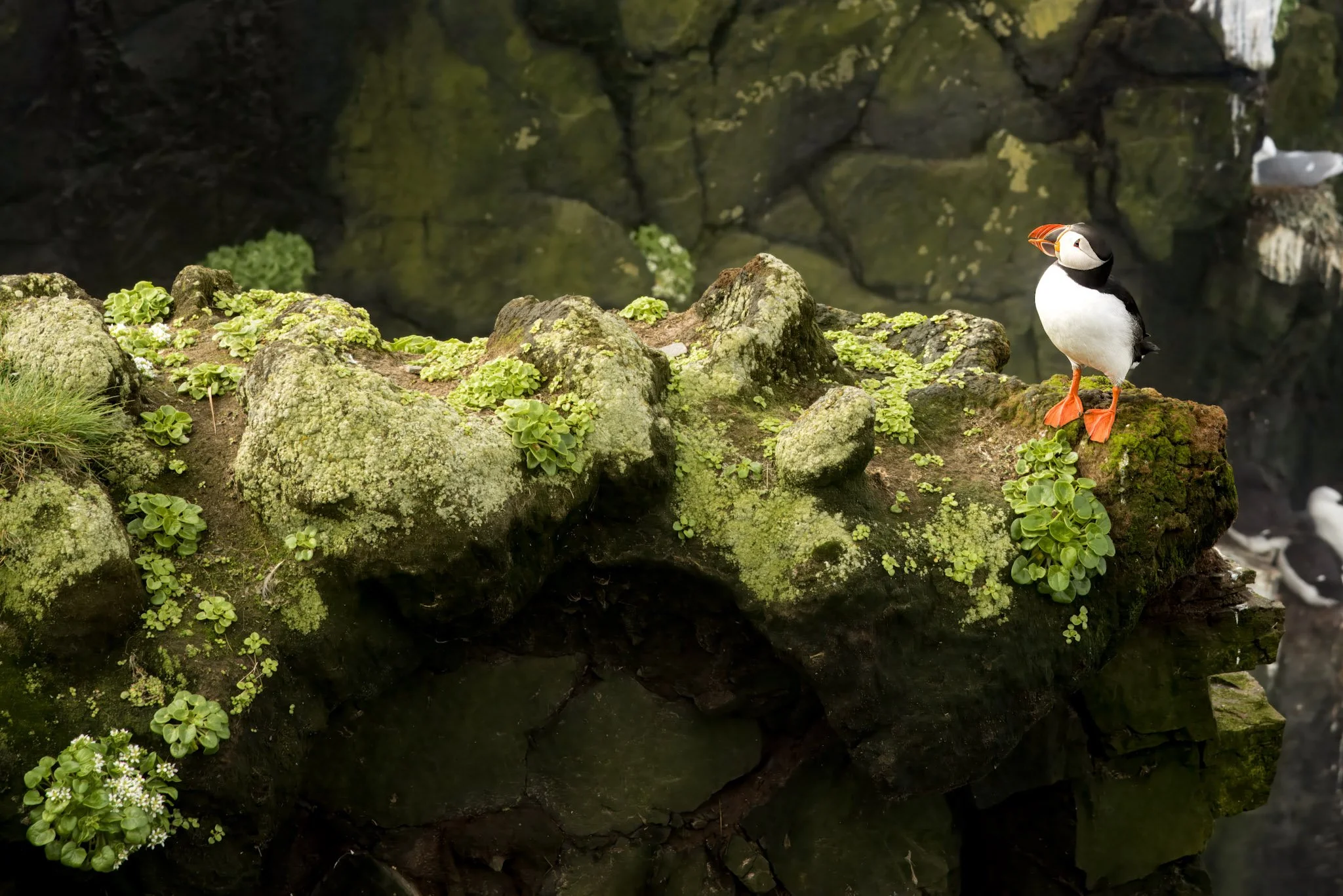
A puffin perches on the edge of the steep icelandic cliffs. Nikon D810.
Looking back, I spent too long applying best practices before I had any real sense of what I actually responded to in a photograph. Guides are useful, but they work better as a way to examine something that already feels incomplete than as a starting template. An eye needs room to develop before it is corrected too carefully. If you begin by trying to avoid every possible mistake, you often end up avoiding self discovery as well.
Some of my least interesting images are the ones that followed conventional rules most faithfully. A few of the ones I still return to began as experiments or near-misses. The willingness to get things wrong, at least in the beginning, seems necessary if a more personal way of working is ever to emerge.
A wildlife photograph can be technically sound and still feel empty. Sharpness, correct exposure, and clean composition are necessary foundations, but they are not sufficient. The frames that continue to hold attention usually do something beyond showing that an animal was present. They create a sense of presence, or they suggest a larger moment that continues outside the edges of the picture.
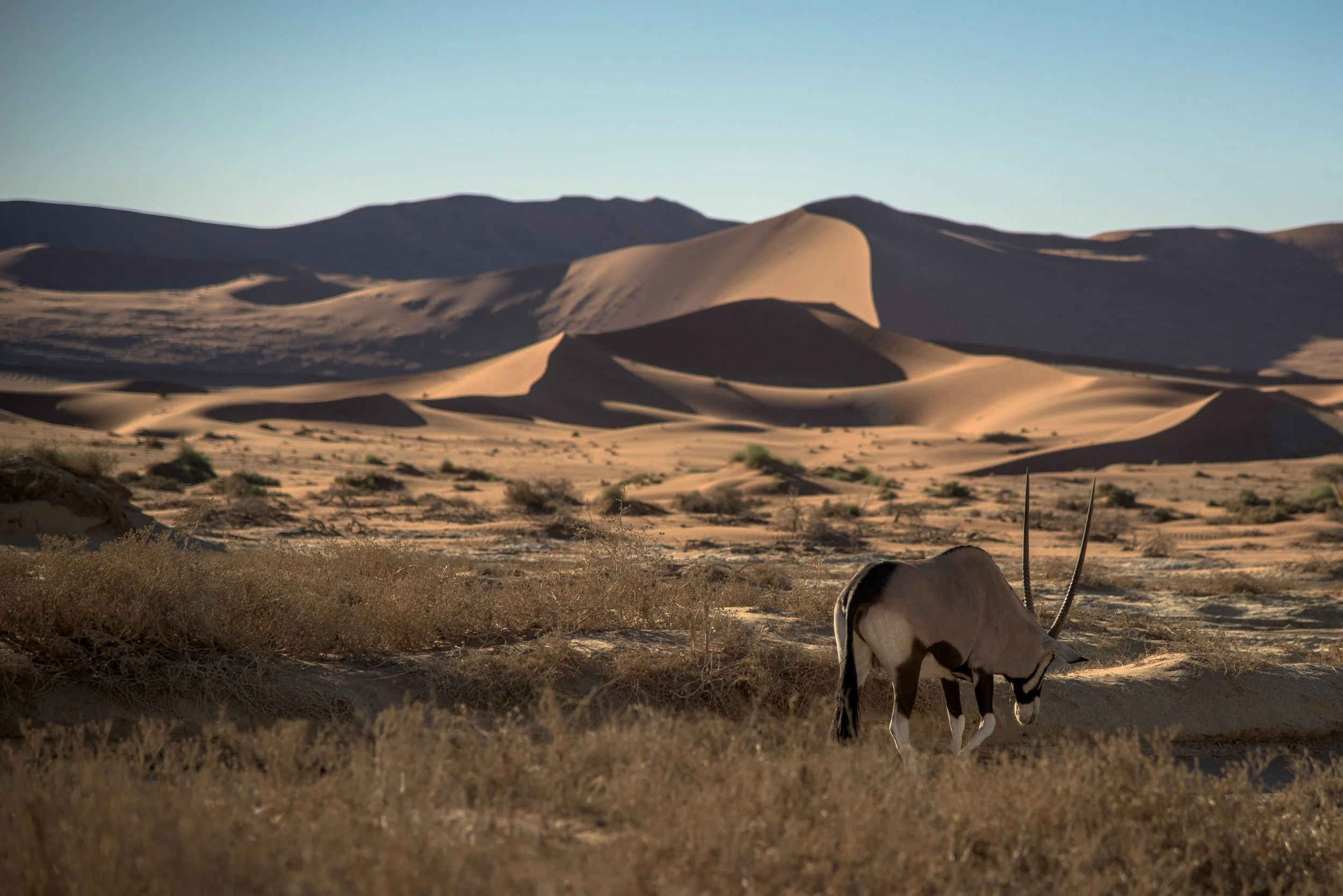
A solitary oryx walks through the arid, sun-baked landscape near Sossusvlei in the Namib Desert.
How to capture your image
I find it useful to carry a few rough questions into the field:
What do I actually want the viewer to notice or feel?
What does the animal’s posture or expression seem to communicate?
Am I after a fleeting instant, or something that feels more considered?
These questions are not abstract. They influence concrete decisions: how close to approach, whether to include environment or isolate the subject, whether to prioritise behaviour over perfect light, and how much space to leave around the animal. Light, shape, colour and composition matter, but mostly as tools for that intention. A clean background or a strong angle only becomes interesting when it serves the larger feeling of the image. Without some underlying intention, even well-executed photographs tend to feel interchangeable.
Understanding wildlife is key
The least glamorous part of the work is also, over time, the most decisive. Technical skill helps you avoid missing the moment. Knowledge of behaviour and habitat helps you be present when the moment arrives. It is one thing to react quickly when an animal appears. It is another to understand likely patterns of movement, preferred feeding times, responses to light and weather, or the small signals that precede more interesting action. That kind of knowledge rarely comes from a single outing. It accumulates slowly through repeated observation.
The more time you spend watching how a species moves, feeds, reacts to light, or uses the landscape, the less you rely on pure luck. You begin to anticipate rather than merely react. Fieldcraft is not a separate skill from photography. In wildlife work it forms part of the same process.

A dramatic moment at golden hour as a hippo rears up with jaws wide open, draped in river weed, in Tanzania, Selous National Park.
This does not mean every strong image requires deep specialised knowledge. Chance still plays a large role. But over a body of work, the advantage of familiarity becomes clear. The photographer who understands the subject tends to produce a higher proportion of images that feel considered rather than accidental.
None of this forms a reliable formula. Strong photographs still depend on timing, patience, and a certain amount of stubbornness. There are days when everything aligns and days when nothing does, regardless of preparation or skill. What I have found, however, is that the images that feel alive to me usually come from some combination of personal vision, attention, and real familiarity with the subject — not from perfect technique alone. Technique supports those things. It rarely replaces them.
The goal is not to eliminate uncertainty or to master a fixed set of rules. It is to develop a way of working that leaves room for both intention and surprise. That balance, more than any particular camera setting or compositional device, seems to me what separates photographs that merely record from those that continue to hold interest.